 |
| Preparing beds |
Showing posts with label winter. Show all posts
Showing posts with label winter. Show all posts
26 February 2017
What to do in the vegetable garden in February
February, for me, is the start of the gardening year. The days get longer and the sun stronger. The very first signs of spring appear as the garden starts to shrug off its winter dormancy. February is too early to do much sowing, but is the month to plan and prepare for the gardening year ahead. It is a time to harvest the last of the winter veg, and to start preparing the ground for the first spring sowings. Here's what I am up to in the garden this month.

15 February 2017
Seville Orange Possets
Citrus fruits are one of the culinary joys of winter. Their bright colours and zingy flavours bring a ray of sunshine to cold days and dark evenings. Seville oranges are a bitter variety of orange, available only for a few short weeks in January and early February. Seville oranges are usually used for making marmalade, but their culinary uses go well beyond preserves. Possets are one of my favourite desserts. They are easy to make, and can be made in advance if you have guests coming round and simply whipped out the fridge for serving. Possets are typically made with lemons, but work equally as well with Seville oranges, which give a nice twist to this classic dessert.
 |
| Seville oranges |
11 January 2017
Winter salad leaves
I love the hearty stews, roasts and other comfort food we all eat in winter, but sometimes I get the urge for a good salad. Particularly post Christmas, when it is easy to feel one has over-indulged during the festive periods. It is good to get a bit inventive with winter salads, and I like to include things like julienned root veg, citrus fruit and finely sliced sprouts, but a few interesting leaves always help meld a salad together. Many gardeners grow salad leaves in summer, but far fewer grow them in winter. There are in fact many salad leaves that will grow in winter. Here a few to have a go with.
8 December 2016
Pickled herrings
Herrings are a hugely populous fish, and are often landed at Channel fishing ports in winter. They usually swim in large shoals, so when caught are often caught in large numbers. They also deteriorate quickly. As a result, herrings are often preserved. Smoking - either as kippers or less commonly bloaters, salting or pickling are the common methods in the UK. Fermentation is also popular in Scandinavian countries. I love a good pickled herring, but I find the shop-bought ones a bit too sweet and vinegary. Better to do it yourself. If a good catch of herrings has come in at the fishmongers, I often pickle a whole batch of them. They keep well in the fridge, and make an excellent lunch or starter.
 |
| Pickled herrings |
25 January 2016
Are chard roots edible? (and are they worth eating?)
At the weekend, I was clearing some old chard plants from a bed, and was surprised by quite how large their roots were. Some of them were the size of a large carrot. It got me wondering, are they edible? And if so, are they worth eating? The edibility question is easily answered. Chard is a close relative of the beetroot, and they share a common ancestor. From this common ancestor, our forefathers developed two strains, beetroot primarily for its sweet roots, and chard for its tasty leaves. Chard has a biennial life cycle, and in its first year mainly puts on green growth. When it overwinters, some of its leaves die back, and the plant develops a large root in which it stores energy, from which to put forth a flower stalk the following spring. Chard's closeness to beetroot means that this root clearly can be eaten, which leaves the second question, is it worth it?
 |
| Chard roots |
4 January 2016
Braised duck with peas
Braised duck with peas is something of a French classic, and is what we enjoyed for Christmas dinner chez Room for a Radish. Although fresh peas are in season in summer, the dish works equally well with frozen peas, and in many ways seems more suited to cold winter evenings than the summer. I take the legs off the duck and confit them - partly because I find the legs a bit dull braised, but mostly because I love confit duck. If you are in a hurry you can miss out the confiting. Depending on how many people you are feeding, you can either eat the confit legs with the rest of the duck, or save them for another day. The recipe uses a fairly large duck, and should feed four or five people, but if you have fewer diners simply purchase a smaller duck. The recipe also works nicely with mallard.
 |
| Braised duck with peas |
10 December 2015
Linguine with smoked trout and watercress
A few weeks ago, we dropped in to see some friends who own a trout fishery at Avington in Hampshire. It's a lovely place, and while I'm not a game fisherman myself, I can see the attraction of wiling away a few hours stalking trout. One of the things about the place that excites me the most is that they have their own smoker, and cold smoke trout from the lakes. The smoked trout and salmon that you buy in the supermarkets is often a bit dull and flabby, but this stuff is the real thing: produced in small batches, with a firm texture and a full smoky flavour. We came away with a side of smoked fish. I used some in a pasta dish - linguine with smoked trout and watercress.
 |
| Linguine with smoked trout and watercress |
30 November 2015
Leeks vinaigrette
Leeks are one of the stalwarts of the winter vegetable plot. At this time of year most of the available green vegetables, such as cabbages, sprouts and kale, come from the brassica family and have a certain similarity in flavour. Leeks, which are alliums and related to onions and garlic, provide a distinctly different flavour. Leeks are fully hardy, and will stand through the coldest of weather. They are often a bit player, appearing in stews and pies alongside many other veg, but are such a tasty vegetable that sometimes they deserve to be the star of the show. One of my favourite leek dishes - and very easy to prepare - is the French bistro classic: leeks vinaigrette.


14 January 2015
Seville Orange Marmalade
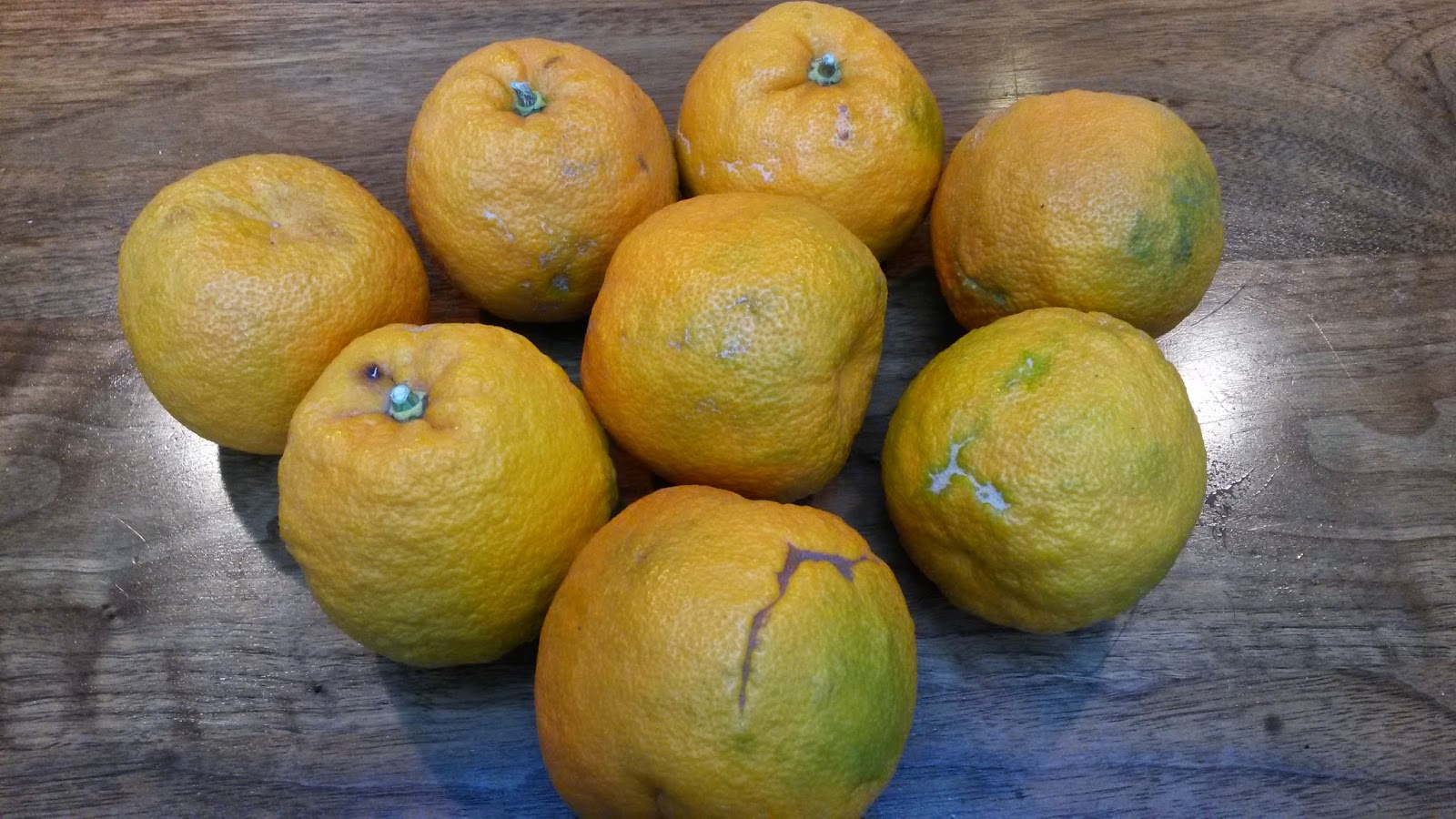 |
| Seville oranges |
On a wet and windy Saturday morning in early January, I was pleased to find several boxes of Seville oranges on sale at my local greengrocers. Suddenly I knew what I was going to do on such a dismal weekend: make marmalade. These lumpy and often misshapen oranges are available for a few short weeks in January. As the name suggests, Seville oranges are grown around Seville, primarily for British marmalade production - apparently the Spanish aren't big fans and don't keep many for themselves.
6 January 2015
Blood orange, radicchio and florence fennel salad

I love winter food: stews, roasts and pies feel right on cold, damp days. Sometimes though, I get the urge for a good salad. This is a tasty little salad with a southern European feel, using some seasonal winter produce. It works well as a starter, a palate cleanser after a heavy meal, or with grilled fish. The tangy citrus of the blood orange works nicely with the bitter radicchio and mild aniseed flavour of the fennel. Like all salads, it is more of a suggestion than a rigid recipe. If you like aniseed, you could also add in a small bunch of roughly chopped chervil. Before blood oranges are in season you could use satsumas. Serves 4-6.
30 December 2014
Roast goose
Goose has been a firm Christmas dinner favourite in the Turpin household since I was a child. We had occasional flirtations with capons and venison, and on one occasion turkey, but time and again we returned to the goose. Roast goose has a great flavour, and provides the appropriate sense of occasion for a Christmas dinner. It has a dark red meat, and tastes a bit like a cross between duck and beef. Goose was a popular Christmas roast in the UK during Victorian times, but during the twentieth century was overtaken by turkey. It has seen something of a return to popularity in recent years.
28 December 2014
Blood Orange Sorbet
December heralds the start of the season for citrus fruits, which are harvested in southern Europe during the winter months. Satsumas, clementines and Sicilian lemons all appear on the greengrocers' shelves. The citrus flavours and bright colours make a great contrast to the brassicas and root vegetables which are also in season at this time of year. One of my favourite citrus fruits is the blood orange, which usually appears in late December. My greengrocers got a single box shortly before Christmas, and I am such a sucker for a blood orange that I bought about half of them. Blood oranges have a particularly fresh flavour, and a great balance of sweet and sour, which epitomise the tangy quality that makes citrus such a great flavour. The flesh of blood oranges is flecked with red, which gives them their name. This strong colour also makes a great visual impact. (Some blood oranges are bloodier than others - the batch I used in this recipe were fairly bloodless.)
 |
| Blood oranges and Sicilian lemons |
15 December 2014
Roast Partridge with puy lentils
 | ||
| Roast partridge on puy lentils |
Partridge is one of my favourite game birds. Many game aficionados get excited about the beginning of the grouse season, and I do too. But it is the unheralded arrival of partridges in early September that really gets me excited about game. Partridge has a pretty long season - from 1 September to 1 February in Great Britain. Like pheasant, partridge has relatively pale, pink-tinged flesh, with a more delicate, sweeter flavour than pheasant. It is a smallish bird, and conveniently a whole bird is just about the right size for a single portion. Like most game birds, it is fairly lean, and can easily become dry. The secret to roasting partridges so that they stay moist is to brown them off in a frying pan, and then pop them in a hot oven for just a few minutes. The same method also works well for grouse and wood pigeon.
14 November 2014
I'm not the pheasant plucker, I'm the pheasant plucker's son...

Subscribe to:
Posts (Atom)