Veal used to be one of those meats that, like foie gras, one
was not supposed to eat. It was pretty tasty, but the way it was produced was
not very humane. Happily, welfare standards are much better than they used to
be for veal calves, at least in the UK. I have to say I am pretty pleased,
being partial as I am to a nice bit of veal now and then. English rose veal has
grown in popularity in recent years, and in many ways it is an ethical choice
for us carnivores who like to know that our meat lived reasonably decent lives
before hitting our plates. One of the sad facts of the dairy industry in this
country is that on many farms, male dairy calves are of no use and hence
destroyed at birth. If more people ate veal, more of these animals would be
given some kind of life and a useful role in the food chain.
23 March 2015
22 March 2015
Ground elder frittata
We recently did that thing, the one where you decide to move out of South London to Brighton, or to be more accurate, Hove. (I hesitate to conform to stereotype and use the word 'actually'.) We have a new garden. It is sunny, and a good size - a little overgrown, but full of potential. We have started clearing the garden, but with the onset of spring I noticed the appearance of ground elder. Ground elder is a fairly invasive, fast-growing plant, which can be hard to clear from a garden. It is a member of the carrot family, and has leaves that look a bit like celery leaves. Ground elder is edible, and I have heard that in the spring it makes good eating. I picked a young sprig, and gave it a nibble. It had a mild, pleasant flavour - somewhere between celery and parsley (both of which it is related to). Surprisingly tasty for a plant that can be the bane of many gardeners' lives. The flavour gets stronger and less pleasant as the plant gets older, particularly once it has set flower. Its edibility is in fact the reason why we have ground elder in the UK. Apparently it was introduced here by the Romans as a food plant.
![]() |
| Ground elder in the border |
4 March 2015
What's in season in March
March heralds the beginning of spring. Not that it necessarily brings milder
weather; apparently in England we are more likely to get snow in March than in
December. The days are definitely getting longer, and that in itself springs
many plants into action. For those excited about eating a plethora of exciting UK-grown spring produce, March can be
something of a disappointment. Early spring is what used to be known as the hungry
gap – a hiatus between the disappearance of winter staples and the appearance
of the first spring produce. If you have a veg plot, March is a good time to
start sowing seeds, and thinking of all the produce you will be harvesting
later in the year, rather than a time when much can actually be harvested.
1 March 2015
Trouble with gluten?
I have been baking bread at home now for several years. I find it a deeply satisfying process. There is something magical about taking four basic ingredients: flour, water, salt and yeast (sometimes in the form of a sourdough starter), and with a bit of kneading, fermentation, shaping and baking, turning them into a loaf of bread. And what bread too! The flavour of home-baked bread far surpasses that of supermarket bread and much of that found in high street bakeries.
4 February 2015
What's in season in February
February is a funny old month. It is the month that in the UK can bring some
of the harshest winter weather, and I write this having travelled through a
fair bit of snow to get to work today. People are usually getting sick of
winter, but spring still seems a way off. That said, the days are
definitely getting longer, and towards the end of the month we sometimes get
the odd nice day that suggests that spring is maybe not so far away. It is a
similar story in terms of seasonal ingredients, at the start of the month we're
still looking at a lot of winter staples: roots and brassicas, and we wave
goodbye to most game birds for another season, but towards the end of the month
we start to see a few new things that hint of the approaching change of seasons.
14 January 2015
Seville Orange Marmalade
![]() |
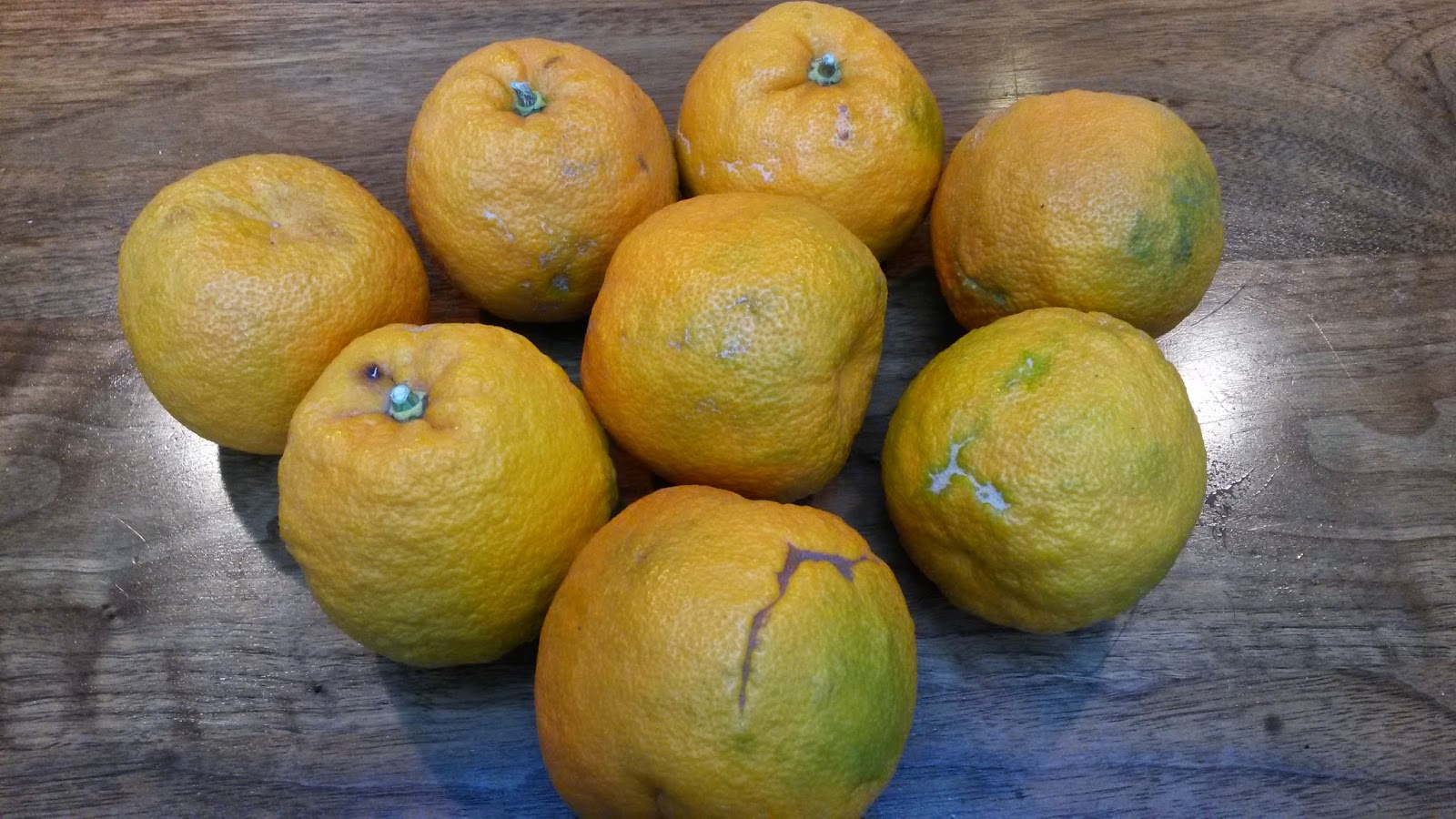
| Seville oranges |
On a wet and windy Saturday morning in early January, I was pleased to find several boxes of Seville oranges on sale at my local greengrocers. Suddenly I knew what I was going to do on such a dismal weekend: make marmalade. These lumpy and often misshapen oranges are available for a few short weeks in January. As the name suggests, Seville oranges are grown around Seville, primarily for British marmalade production - apparently the Spanish aren't big fans and don't keep many for themselves.
6 January 2015
Blood orange, radicchio and florence fennel salad
I love winter food: stews, roasts and pies feel right on cold, damp days. Sometimes though, I get the urge for a good salad. This is a tasty little salad with a southern European feel, using some seasonal winter produce. It works well as a starter, a palate cleanser after a heavy meal, or with grilled fish. The tangy citrus of the blood orange works nicely with the bitter radicchio and mild aniseed flavour of the fennel. Like all salads, it is more of a suggestion than a rigid recipe. If you like aniseed, you could also add in a small bunch of roughly chopped chervil. Before blood oranges are in season you could use satsumas. Serves 4-6.
Subscribe to:
Posts (Atom)